Choose Your Country

Designing a dog-friendly garden means thinking like your dog. From pet-safe plants and soft pathways to shade trees and water sources, a well-planned yard keeps dogs healthy, comfortable, and happily engaged.
The dog cocked her head, one ear up. “Well,” she said, “I want a garden with a sturdy fence delimiting my yard but with at least one viewing spot to sniff at passing dogs or to see whatever made that sound.”
The more she thought, the more things she thought of:
- Unimpeded paths to dash down.
- …with big trees for shade on a hot day.
- In this garden, any stick is a good stick to fetch, and if I chew on a plant, it doesn’t upset my stomach.
- No plants with seeds that catch in my fur.
- No plants with spines or thorns at nose-level.
- No spots that hurt my feet.
- A place to drink fresh water.
- A comfortable bathroom space.
- My-sized places that are dry when it rains.
- And places that are warm on a cold night.
- Little clumps of plants to sniff into and open areas for digging.
She paused, then added hopefully, “I don’t suppose you could include rabbits and squirrels for chasing, could you?”
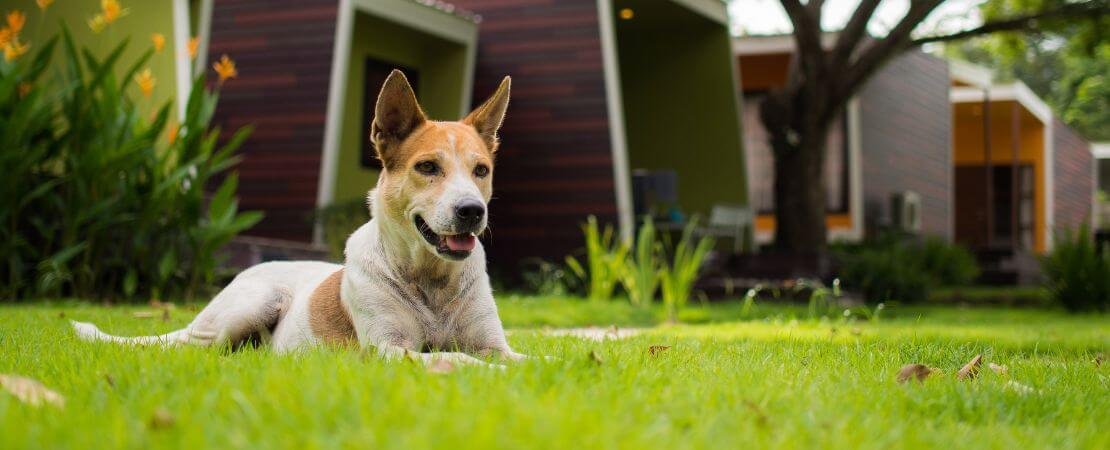
A dog-friendly yard is safe for the dog and full of things that engage canine interest.
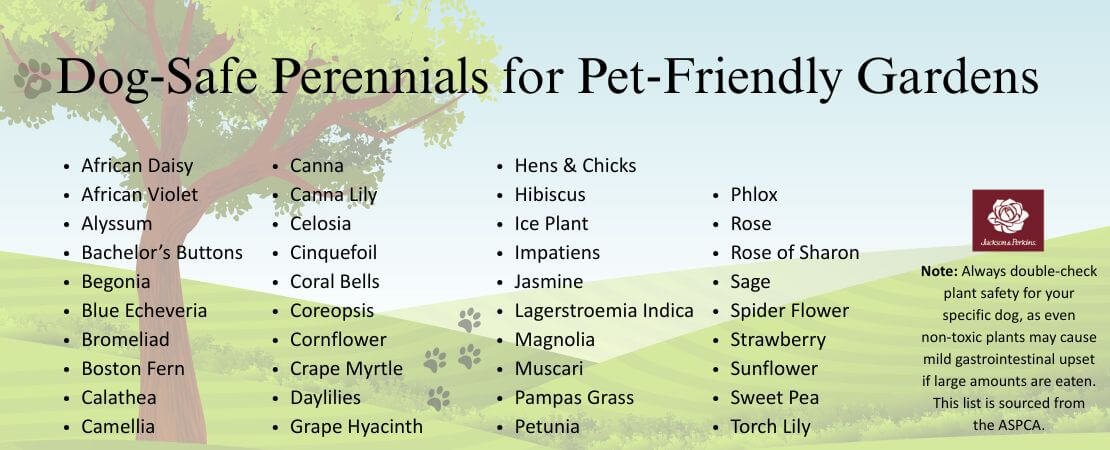
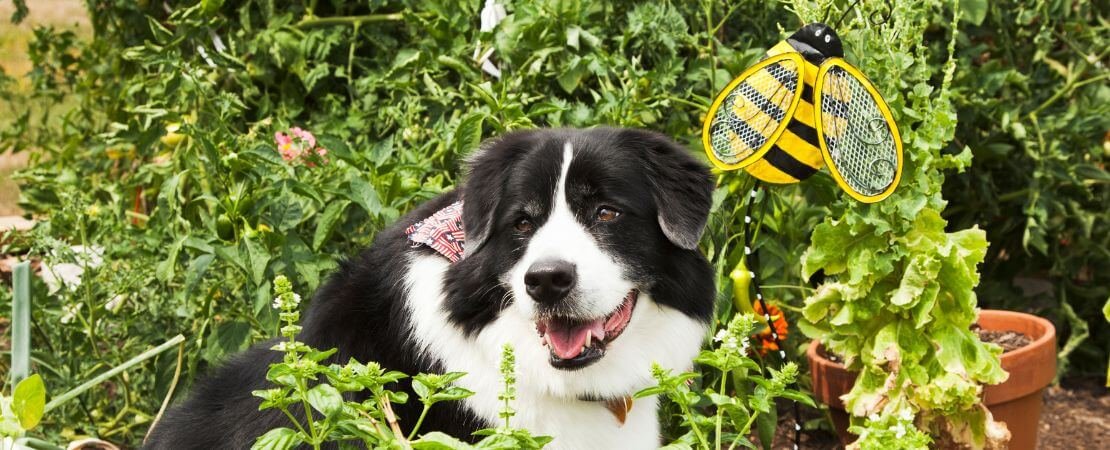
Smaller plants for yards with dogs include marigolds (Tagetes), snapdragons (Antirrhinum), lavenders (Lavandula), rosemary (Salvia rosmarinus) and other salvias, and lots of colorful flowers like black-eyed Susans (Rudbeckia), blanketflowers (Gaillardia) and coneflowers (Echinacea); there are hundreds of choices. Grow vegetables that your dog likes, perhaps green beans (Phaseolus), cranberries (Vaccinium) or strawberries (Fragaria).
A good fence clearly marks the dog’s territory and prevents roaming. If there is a lot of foot traffic outside it might be necessary to have it solid, so the activity won’t continuously disturb the dog. Many kinds of fences work; the dog, the neighborhood, and the climate will determine the best choice.
Paths should be grass or a ground cover, or sand, or mulch. Cedar chip mulch is often recommended. Plants or mulch on the path are good so the dog doesn’t come in with mud-covered feet. Lawn grasses work, but so do sedges (for example Pennsylvania sedge, Carex pensylvanica), thymes (Thymus praecox and T. serpyllum), creeping plants like hardy iceplant (Delosperma) and phlox (Phlox hybrids), and clovers (Trifolium repens for example). You can also learn to appreciate whatever local plants colonize the path, whether they are dandelions (Taraxacum officinale) or plantains (Plantago species).
Shade trees take a few years to get big, but on good sites grow quickly. Consider oaks (Quercus) since the acorns attract squirrels. Lindens (Tilia) and dogwoods (Cornus) are other good choices to shelter your dog. Pines (Pinus species), arborvitae (Thuja occidentalis) and hemlocks (Tsuga species) will provide year-round protection. Remove the lowest branches so the dog is welcome under them.
Good choices for shrubs and small trees are cherries (Prunus) and apples (Malus domestica), serviceberry (Amelancher), redbuds (Cercis canadensis), and lilacs (Syringa).
Woody plants that are toxic to dogs when chewed include yews (Taxus), oleander (Oleander), and rhododendrons and azaleas (Rhododendron). Perennial vines that are poisonous to dogs include trumpet creeper (Campsis radicans), grapes (Vitis species), and honeysuckles (Lonicera).
Plants commonly found in gardens that can be toxic to dogs include lily-of-the-valley (Convallaria majus), lilies like Easter lily (Lilium species), lantana (Lantana, especially the berries), hydrangeas (Hydrangea), and hostas (Hosta). Tulip (Tulipa) and daffodil (Narcissus) foliage are mildly toxic, but eating a bulb can be serious for a small dog. Gladiolas (Gladiolus) bulbs are also dangerous. Begonias (Begonia), hyacinths (Hyacinthus), and wood sorrels (Oxalis) have oxalic acid in their leaves that can be toxic in large amounts. Foxgloves (Digitalis) and bluebells (Hyacinthoides non-scripta) contain serious poisons throughout the plant. (Bluebells is the common name of at least three species. Bluebells of Scotland, also called harebells (Campanula rotundifolia) and Virginia or mountain bluebells (Mertensia virginica and related species) are not poisonous to dogs.)
Be careful with onions (Allium cepa) and potatoes (Solanum tuberosum), because although edible to humans, onions can poison dogs and potato leaves are toxic.
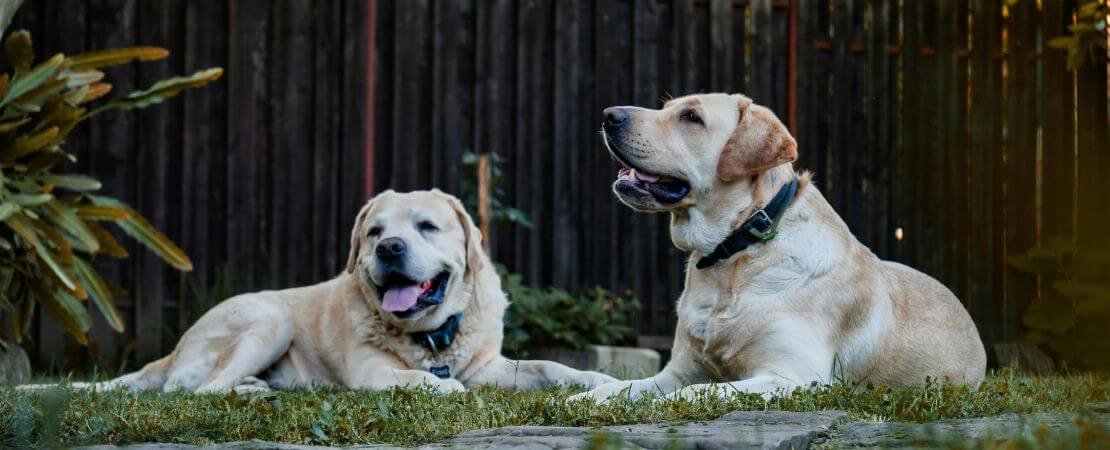
Only a few of our garden plants stick into dog fur, but you might avoid bedstraws (Galium species) and plumbago (Plumbago) because they produce small, sticky seeds.
Spiny garden plants are not especially common, but roses (Rosa), raspberries and blackberries (Rubus species) and barberry (Berberis) are prickly. You can train roses and the berries to have only a main stem at dog-level, but that is not easy with barberries.
Active dogs are hard on gardens. You may need to fence off new plants while they are small. Also, acknowledge that the dog will always disturb the plants, and that is fine; enjoy the dog enjoying the yard.
Surfaces that can be hard on the feet of dogs include places where the pavement gets too hot by late afternoon or gravel with sharp sides.
A source of clean water is very important. Fountains that turn on to motion are easy to maintain. Small ponds work but need fish to prevent growing mosquitos, and, of course, they invite dogs to jump in and get all wet and then muddy—which is a plus for many dogs. Easier is to put out a wading pool in hot weather and take it in in winter.
Create a nice open spot as a bathroom, perhaps with easily cleaned sand. Keep accessible if snow is deep in winter.
Spots deep under trees will be dry in many small rainstorms, but a roof or overhang is even better.
Places for staying outside in cold weather do not have to be heated, but should be out of the wind and small enough that body-heat will be retained, until it’s time to go in.
Set up a bird feeder to attract birds and squirrels. Place it where the birds and squirrels can easily retreat out of reach of the dog, for example along the fence.
Put down some sand or a sand-soil mix in a place good for digging. (Maybe bury a toy there!)
Build low mounds, perhaps tiered, that are easily climbed, to encourage activity and as a vantage point.
Grow ornamental grasses (muhlies (Muhlenbergia) and fescues (Festuca, for example)). These make great places to dodge in and around.
Arrange tall grasses or low tree branches of the right height so the dog can “trance” (walk under them slowly while it brushes against their back, also called ghost walking); apparently a source of great pleasure.
Consider plants in pots—perhaps petunias (Petunia) or pansies (Viola)—that you can move around so there are changes in the yard for the dog to investigate.
Tailor all of this to your dog, or dogs, and enjoy their pleasure.
Note: Scientific names are included throughout to ensure clarity, especially when discussing toxic or dog-safe plants. Many plants share common names, and using botanical names helps avoid confusion and keeps your pet safe.

