Choose Your Country

The story of the Post China Roses is one of the most fascinating turning points in the history of roses. Picture this: Europe in the late 1700s, when trade with China starts to open. Among the treasures brought back are four roses—the famous Four Stud Chinas—that completely changed the game for rose breeding in the West. These roses didn't just bring new colors and forms; they introduced something truly revolutionary: the ability to bloom continuously from spring to fall. That was unheard of in European roses at the time! The impact of these roses was so profound that they shaped the way roses have been bred ever since, giving us the vibrant, repeat-blooming varieties we know and love today. Let's dig into the magic of the Post China Roses and see how they've earned their place in the garden—and in history.

Photo of Old Blush Rose courtesy of Paul Zimmerman Roses Consulting & Design.
As trade with China opened in the latter half of the 18th century it included many plants. Among those were four roses that introduced all new characteristics into the Old European Roses. China roses are twiggy and more compact plants. Most importantly they bloom from nearly every joint on the plant including spent blossoms and then bloom continuously from spring to fall.
Four of these roses were brought to Europe and subsequently used in breeding. They are known as the Four Stud Chinas. They are known today as; 'Old Blush China', 'Slater's Crimson China', 'Parson's Pink China' and 'Hume's Blush Tea Scented China' These roses also introduced a broad color range coming in every shade of red as well as white and pink and some yellow and apricot blossoms.
'Old Blush' in particular was quite prolific and its DNA can be found in many of our modern roses. It's still with us today and there is also a climbing version. Both have charming soft pink blooms and will steadily bloom all season long. The earliest record of 'Old Blush' in Europe appears to be 1781 but it likely appears in old Chinese paintings of the 10th-12th centuries. It is a hybrid rose and not a species rose which demonstrates that the Chinese had been breeding roses for close to a thousand years.
In Europe 'Old Blush' was crossed with 'Autumn Damask' which was one of the few Old European Roses that did have repeat blooming cycles. This gave us the Bourbon Class of roses. 'Old Blush' found its way to America where a rice planter in Charleston, SC crossed it with The Musk Rose and gave us the Noisette class of roses.
These four Stud China Roses played an important role in the history of rose breeding in the west. We owe the characteristics of modern roses to this group. Essentially, they changed rose breeding and roses in the west forever.
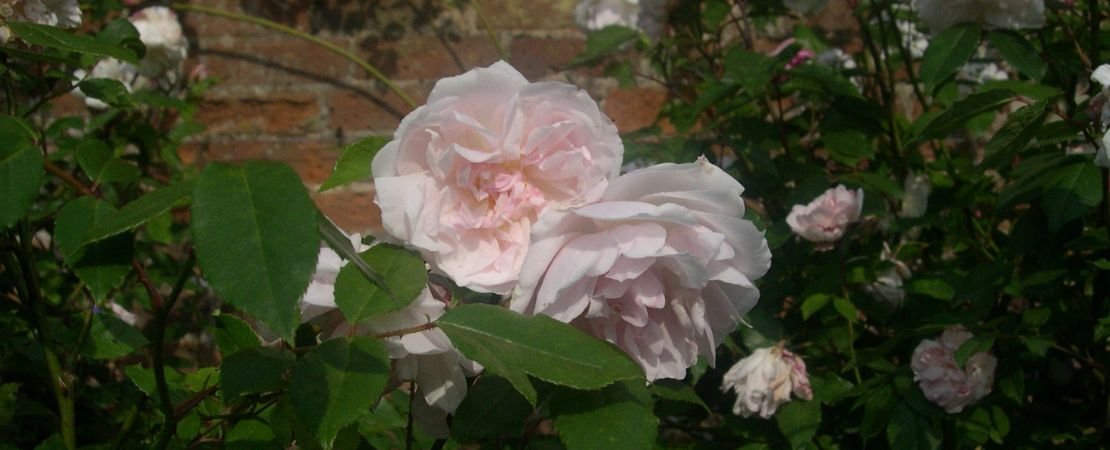
Photo of Hume's Blush Rose courtesy of Paul Zimmerman Roses Consulting & Design.
Once the Four Stud Chinas were introduced into western rose breeding many new classes of repeat flowering roses emerged. All the classes are with us today and many varieties of roses in each class can also still be purchased. Collectively they are a lovely group of repeat flowering shrub and climbing roses that come in varied growth habits, colors and bloom shapes. While some have a stronger fragrance than others, all are scented. Many, like the Tea Rose Class, cut well for use in vases and arrangements. Read on to learn more about the origination and development of the Post China rose classes.
While the Four Stud Chinas were crossed with other roses to get newer classes, breeding also continued with them. The result was a group of roses with a smaller mature size that can not only be grown in the garden but are also ideal for patio pots and containers. They are not cold hardy so growing them in pots in colder climates allows them to be brought into an unheated building in the winter. As previously mentioned, they flower almost nonstop from spring to fall and the color range is broad. The shrubs are twiggy with many joints and side branches.

Photo courtesy of Paul Zimmerman Roses Consulting & Design.
As previously mentioned, this class developed from a cross between 'Old Blush' and 'Autumn Damask'. The cross was made in 1817 on the Isle de Bourbon, hence their name. In their day they were an enormously popular group of roses due to their repeat flowering and sweet scent. Many are still with us today and are worth adding to your garden. The shrubs tend to throw out longer canes and some can be used as short climbers. Some like 'Souv de la Malmaison' make shorter shrubs every bit as charming as their larger cousins. The leaves are a soft texture of green and they are not overly thorny.

Photo courtesy of Paul Zimmerman Roses Consulting & Design.
Developed in Charleston, SC by the rice planter John Champney this class contains many climbing roses and introduced shades, such as yellow, into the climbing group of roses at the time. Most consider the first Noisette to be 'Champney's Pink Cluster' which was bred around 1803 and introduced in 1811. John Champney soon lost interest in breeding roses but a gentleman with the last name Noisette sent seeds of 'Champney's Pink Cluster' to his brother Philip Noisette in France. Phillip continued the breeding and introduced many fine roses in this class. That is how they became known as Noisettes. They should have perhaps been known as Champneys.
The original Noisettes are a mix of shrubs and climbers. Mostly in shades of white and pink. They were subsequently crossed with Tea Roses and the Tea-Noisette class was created. Essentially a subclass of the Noisettes these are the climbers most often associated with the class. The colors range from white, pink, yellow to apricot. They are outstanding climbers with pliable canes making it easy to train them into all kinds of uses in the garden. They are fragrant with a very good repeat throughout the season. They have a reputation for being tender but in fact most can easily be grown to zone 6.

Photo courtesy of Paul Zimmerman Roses Consulting & Design.
One of the Four Stud Chinas “Hume's Blush Tea Scented China' is considered to be the first Tea Rose in the western world. It's actually 'Rosa x odorata' and was obtained in 1810 from the famous Fa Tee Nursery in Canton by an agent of the East India Company. It was sent to the garden of Sir Abraham Hume who named it 'Hume's Blush' to honor his wife Lady Amelia.
The Tea roses are a class of Old Garden Roses that can easily give any modern rose a run for its money. They are in almost constant bloom, have a lovely sweet scent and make handsome shrubs growing to heights of five feet or more. In warm climates like California they have been known to grow to twelve feet high and across. They do not like being heavily pruned so it's best to leave them alone just cutting out dead wood and the like.
A particularly appealing characteristic of this group is that, on most of the plants, no two blooms are completely alike. While colors are similar across the bush, the shades and nuance of each bloom can vary—even based on the time of day. The shrubs are upright and, like the Chinas, they are twiggy with joints and side branches. The blooms do cut well but they do not stand stiffly upright like our modern Hybrid Teas. They are still charming in arrangements.
Unfortunately the Tea class is not cold hardy. They can easily handle zone 7 and perhaps 6 in a sheltered place. But in the American Southeast they are outstanding roses that seem to love the heat and humidity.

Photo courtesy of Paul Zimmerman Roses Consulting & Design.
This class of roses is considered to be the final stage of development in roses before the introduction of the modern Hybrid Tea roses. They have very large flowers on stiff stems that hold the blooms upright. The stems are not as long as those on Hybrid Teas. They were widely developed for exhibition in rose shows, something else they have in common with Hybrid Teas.
Hybrid Perpetuals are crosses of China Roses with Bourbons and Portlands. Their great years were from the 1850s to the 1890s during which, by some estimates, some 4,000 varieties were introduced. Most of them grow upright in shape but some will sprawl. They can become quite large. They are cold hardy and many can easily handle the climate to zone 5. This is due to the old European Rose Heritage they have. As a class they have good fragrance and since they cut well for vases they can easily be brought into the house. They are repeat flowering but not constant flowering. The bloom in flushes throughout the season.
The Post China Roses mark a pivotal moment in rose history, blending the charm of Old European Roses with the transformative traits of Chinese varieties. At the heart of this shift are the Four Stud Chinas which introduced repeat blooming, vibrant colors, and compact growth habits to the West.
Post China roses laid the foundation for beloved rose classes like Bourbons, Noisettes, Teas, and Hybrid Perpetuals. Each expanded the possibilities for gardeners, offering rose options for every climate, garden space, and purpose.

