Choose Your Country

A row of roses can soften a chain-link fence, edge a driveway, or give a patio a little breathing room from the yard next door. The best roses for hedges have enough branching to fill the row, a mature size that fits the space, and flowers that return through the growing season.
Start with the height you need. A compact shrub can mark a boundary without hiding the garden. A taller hedge can screen a seated view, while a climbing rose trained on a support can carry the flowers higher. Then check the variety's mature width and growing zones before deciding how many plants to buy.
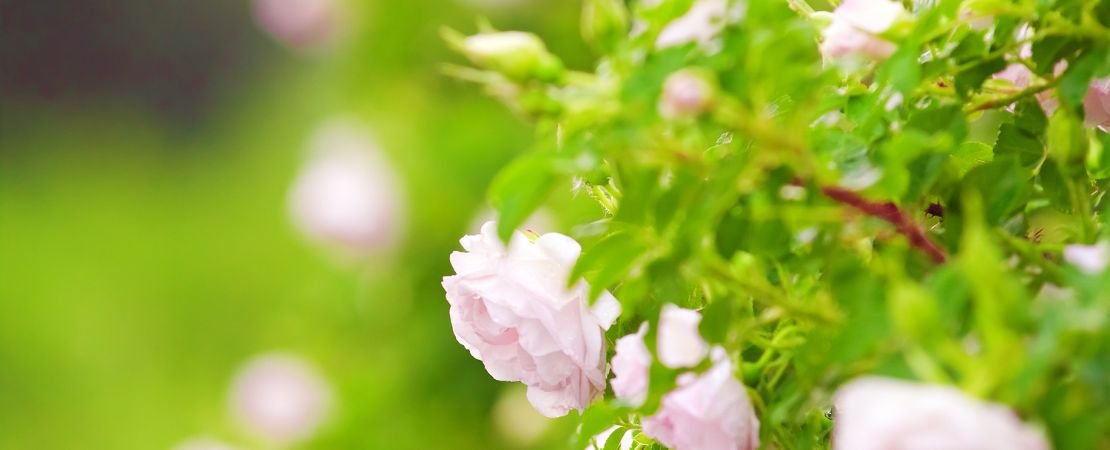
The best shrub roses for a hedge combine a bushy habit, repeat flowering, and disease resistance suited to your growing conditions. Healthy foliage matters as much as the flowers: it is the leaves and branches that give the row its substance between flushes of bloom.
For an even-looking hedge, repeat one variety. Mixing colors can work, too, but compare mature heights and widths so one rose does not overwhelm its neighbors. Choose a plant that naturally grows close to your intended hedge height rather than relying on frequent cutting to keep a larger rose small.
Our Simplicity Hedge Roses are a useful place to begin. Introduced by Jackson & Perkins in 1979, the series was developed for dense, branching growth and repeat bloom.
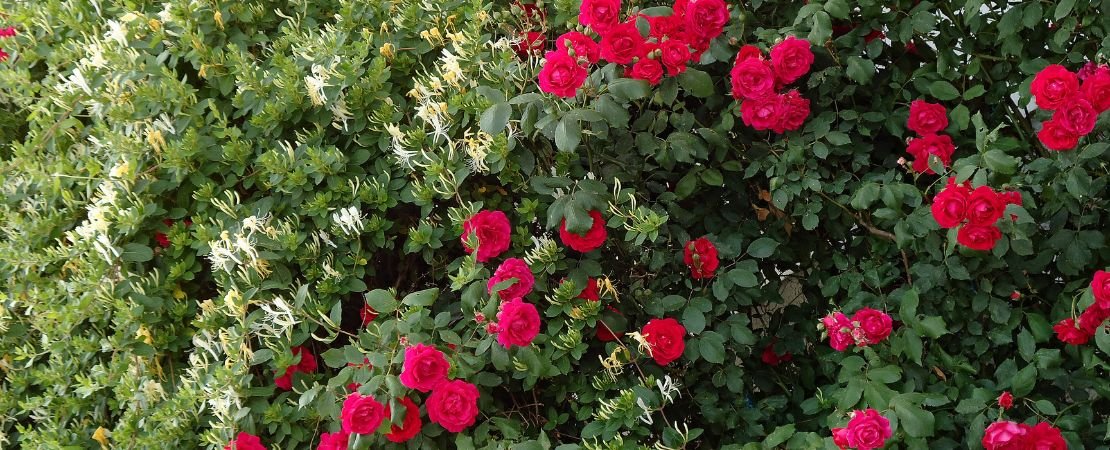
The original pink Simplicity Hedge Rose grows 4 to 5 feet tall and 2 to 3 feet wide in Zones 5 to 10. Its upright, densely branched habit suits a continuous hedge, and its lightly fragrant, double pink flowers return in waves. It is also listed as disease resistant and tolerant of heat and humidity.
Prefer white flowers? White Simplicity Hedge Rose has the same listed height, width, and zone range, with lightly scented white blooms. Either makes a good starting point for a flowering boundary beside a lawn or patio.
Pink Double Knock Out Shrub Rose grows 3 to 4 feet tall and wide in Zones 5 to 11. Its bushy habit and bright pink double flowers suit a lower hedge where you still want to see across the garden. Its disease resistance makes it a practical choice for gardeners who want less routine upkeep.
If a shrub hedge will not reach high enough, consider a supported climber. Cloud 10 Climbing Rose is listed at 7 to 8 feet tall and 5 feet wide in Zones 5 to 10. It bears white flowers with pale yellow centers and repeat blooms after its heavy spring display. Train its canes along a suitable fence or trellis; that support is part of the plan for a taller screen.
When choosing roses for privacy, check the view from the place you actually sit. A 4-foot hedge may soften the view from a chair while leaving a standing sightline open. In cold climates, winter leaf loss also reduces screening. If privacy matters throughout the year, plan the roses alongside a fence or an evergreen planting.
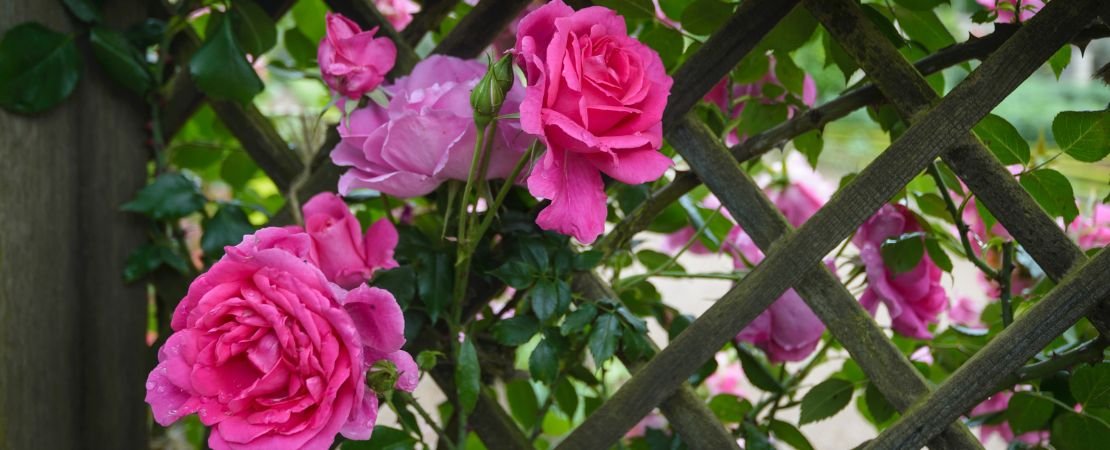
To train a climbing rose on a fence, tie the canes to the fence as they grow and guide them in the direction you want. A climber has no tendrils or clinging roots. Left alone, its stems grow in whatever direction they choose, so the training is what turns it into a screen.
A climber needs something to lean on, like a fence, trellis, arbor or posts. If the support is a wall, use a free-standing trellis or frame that sits a few inches out from the surface. That gap gives the plant air movement, and good air circulation helps keep a climbing rose healthier.
Secure each cane to the support with soft rubber or plastic twist ties, the kind with a spongy, cushioned coating over a wire core. They hold firmly and protect the bark from rubbing. Coated garden wire works too, and you can cut it to the length you need and wrap it gently around the cane. Keep an eye on the plant as it grows. New canes will want to head upward and outward, so redirect them toward the open parts of the fence. Tie loosely so the ties never cut into a cane as it thickens.
To cover a long fence, train the canes sideways in a fan instead of straight up. Our Climbing Roses collection describes this approach, sometimes called a crawling rose, with canes trained horizontally along a fence line. It fills a long, low fence with bloom instead of sending all the growth to the top.
Hold off on heavy pruning for the first few years, because hard cuts can undo the training you've done. Once the rose is established, prune it about once a year to remove dead, damaged and crossing canes and tidy the shape. For more on how climbers grow and how to shape them, see our Guide to Climbing Roses.
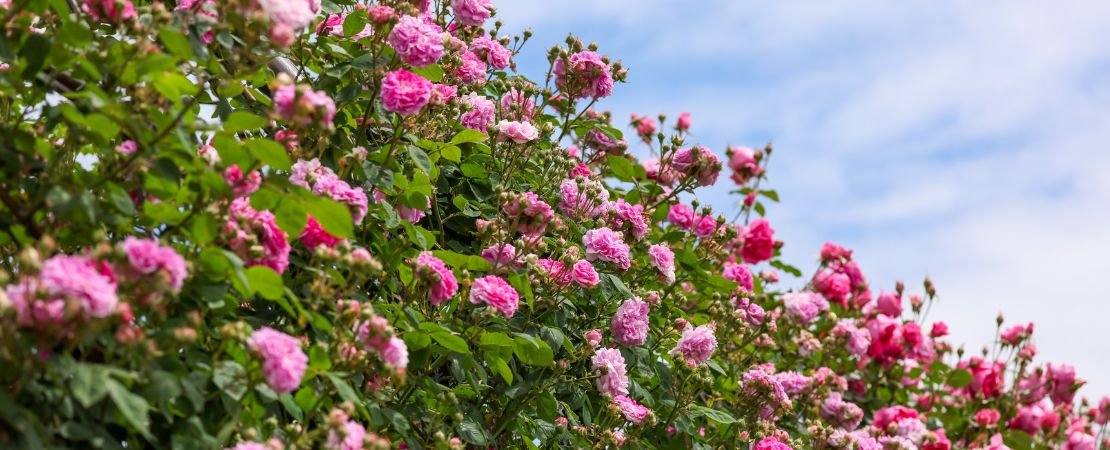
Measure spacing from the center of one plant to the center of the next. Our Rose Spacing Guide suggests 24 inches for hedge roses, 24 to 30 inches for floribundas and small shrubs, 30 to 36 inches for large shrubs, and 4 to 5 feet for climbers. Treat those as starting points: the variety's mature spread and the room available for air circulation should guide the final layout.
For a rose hedge such as Simplicity, 24 inches between centers is a useful planning distance. A broader shrub may need more room. Avoid squeezing every variety into the closest spacing just to hide the gaps on planting day.
For a 20-foot bed, these two layouts leave half the chosen spacing between each end of the bed and the nearest plant center:
The distinction matters when counting plants. Nine roses at 30-inch spacing span 20 feet from the first plant center to the last, leaving their branches to extend beyond that measured length. Before ordering, mark the centers on the ground and check the end clearances. Along a walkway, allow enough room for mature branches and prickles to stay out of passing traffic.
Choose a site with at least six hours of direct sun, well-drained soil, and good air movement. Morning sun is helpful where it dries damp foliage. Check conditions along the entire row; the shady end beside a building may perform differently from the sunny end.
Lay out the plants before digging, and follow the planting instructions supplied with your roses. Planting depth depends on whether the rose is grafted or growing on its own roots, as well as your climate. Our rose care videos include help with both bare root and container roses.
Water the root zone thoroughly after planting, and check soil moisture regularly while the plants establish. A soaker hose makes it easier to water a long row while keeping foliage dry. Add 2 to 3 inches of organic mulch, leaving about 6 inches clear around each plant's base. Adjust watering for rainfall, heat, and soil conditions; the goal is evenly moist soil with good drainage. Illinois Extension's rose care guidance explains watering and mulching in more detail.
For repeat-flowering shrub roses, plan the main pruning in early spring, with timing adjusted to local conditions and the variety's instructions. Remove dead or damaged wood, thin crowded growth as needed, and shape each plant with its neighbors in mind.
Want fewer spent flowers to tidy? Pink Double Knock Out is self-cleaning, so there's no need to deadhead it. That makes it an especially practical choice for a long flowering hedge.
If you choose a climbing screen, keep and train the long framework canes, removing damaged wood and pruning side shoots as appropriate for the variety. Illinois Extension's pruning guide explains how care differs between shrub roses and climbers.
Start with a rose that fits the space, give the row room to grow, and let its natural habit guide the shape. A well-planned hedge can bring the flowers close enough to enjoy every time you walk past.
An upright, repeat blooming, disease resistant shrub rose or floribunda. The Simplicity Hedge Rose was bred for hedges and has been grown since 1979.
24 to 36 inches apart for most shrub roses and floribundas, and 4 to 5 feet for climbers. Plants that tolerate dense planting can go at the close end of that range.
Convert the hedge length to inches, divide by the spacing, and add one. A 20 foot hedge at 30 inches apart takes 9 roses.
Most shrub roses reach 3 to 5 feet. Simplicity Hedge Rose grows 4 to 5 feet tall, Pink Double Knock Out 3 to 4 feet, and a climber like Cloud 10 reaches 7 to 8 feet.
Yes, as a flowering screen. Shrub roses block the view up to about 4 or 5 feet, and a climber on a fence or trellis goes higher.
Tie the canes to the fence with soft rubber or plastic twist ties, or coated garden wire, as they grow, and redirect them toward the open spaces. Avoid heavy pruning for the first few years so you don't undo the training.
Yes. Canes can be trained horizontally along a fence line, which covers a long fence with bloom instead of sending all the growth upward.
Yes. A climber needs a fence, trellis, arbor or posts to lean on. Against a wall, use a support that stands a few inches out so air can move behind the plant.
In late winter or early spring, when the leaves begin to emerge. Remove dead, weak and crossing canes, open the center, and shape the row.
It depends on the rose. Deadheading means removing spent flowers. Self-cleaning roses like Pink Double Knock Out don't need it, so check the product page.
Simplicity Hedge Roses grow in zones 5 to 10. Check each rose's product page for its range.

