Choose Your Country

Bulbs are wonderful. You dig them in once and year after year they push out of the soil to bloom.
Crocus (crocus), Tulipa (tulips), and Narcissus (daffodils) are all reliable signs of spring that everyone knows. And they come in an array of delightful colors, sizes, and shapes. But they are just a few of the spring bulbs available. You can also grow Galanthus (snowdrops), Chionodoxa (glory of the snow), Scilla (squills), Hyacinthus (hyacinths), Muscari (grape hyacinths), Anemone (anemones and pasqueflowers) and Iris (irises).
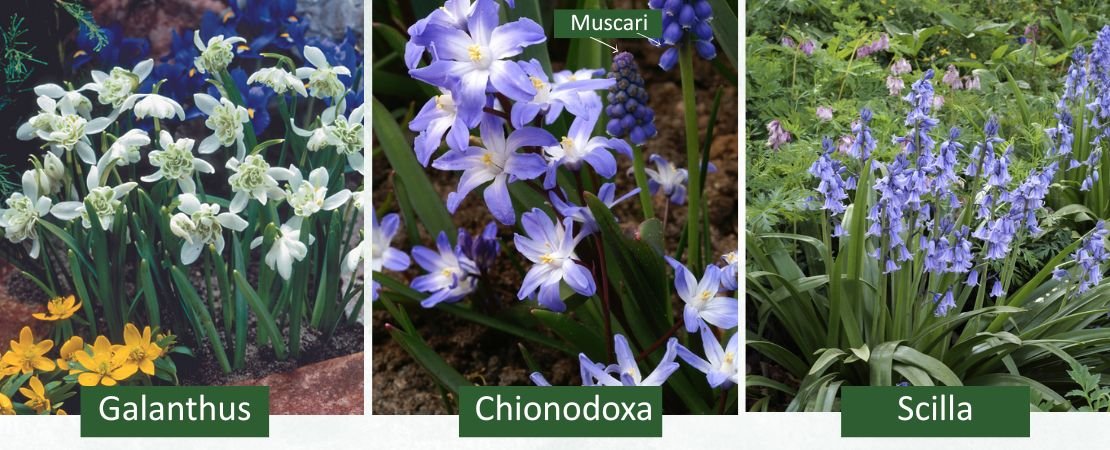
Galanthus, Chionodoxa, and Scilla are short and flower very early; Galanthus has round white flowers that look like the snowdrops of its common name, Chionodoxa and Scilla have blue or white star-shaped flowers. Early bees love them. Muscari have little clusters of blue-purple flowers, fitting their name grape hyacinth. Hyacinths have a dense cluster of relatively large individual flowers and come in a range of colors from deep purple and blue through pink and white. The Anemone varieties are amazingly diverse, from deep purple to white to multicolored flowers, simple open shapes or round flowers of many petals or bell-shaped; the pasqueflowers are a distinctive, beautiful, subgroup of anemones. Iris species grow all over the world, short and tall, early and late, in all the colors of the rainbow (in fact, Iris was the Roman goddess of the rainbow; everywhere she stepped on earth, irises sprang up). Bury these bulbs in the ground in the fall and wait eagerly for spring.
But why stop there? Bulb formation occurs in a wide array of plants, some of which flower every season. (Well, in winter, only indoors, but you can certainly enjoy a midwinter Amaryllis!(Unless you're in Zones 9-11, then Amaryllis are perennials.)
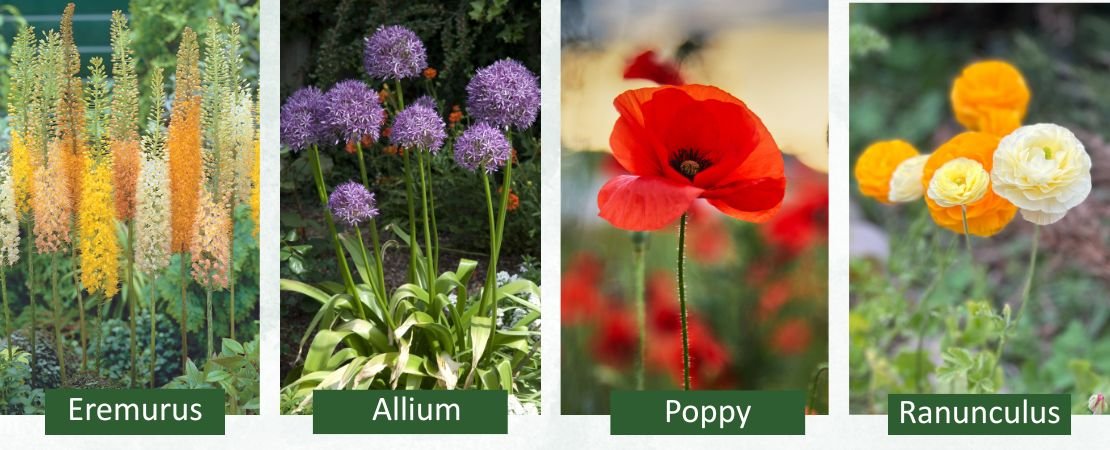
As spring shifts to summer, you can watch for the flowering of bulbs of Eremurus (foxtail lily), Allium (alliums), Papaver (poppies), and Ranunculus (buttercups). Your flower color choices range from striking reds to purples, vibrant yellows to pure white. Most of these will overwinter in colder zones, a few, however, are not winter hardy, for example Ranunculus asiatica, and will need to be planted into a pot that is kept inside until late spring and brought in again in fall. Or you can plant the bulbs after the threat of frost and dig them up to store them indoors somewhere cool and dry, like the basement, over the winter.
But that is only part of the available bulb diversity!

For summer blooms, plant hardy Crocosmia (crocosmias), Gladiolus (gladiolas), Liatris (blazing star), Lilium (lilies including tiger lilies, oriental, Asiatic, roselilies, and tree lilies), and Zantedeschia (calla lilies). These will come up year after year. And they are amazing. Crocosmia have red and orange lily-like flowers hanging like orchid flowers all along the 4' flower stalk. Gladiolus varieties get 3–5' tall with spectacular stalks covered in large intensely colored flowers—red, or yellow or white or purple or combinations. Liatris is a wand of tiny flowers, traditionally lavender but also hot pink and white. Lilium is a huge group, with dozens of varieties available, red, orange, white, pink, multicolored, tall to dwarf, because they are native all over the world and all over the world people brought them into their gardens. And calla lilies are another favorite, with flowers from shining white to nearly black, yellows, oranges, lipstick reds, and more, standing about 3' tall. Because their bulbs store energy, plants grown from bulbs will often flower the first year, so these summer blooms can be planted in spring and many will flower this year. And, being perennial, do it again next year and the year after.

Dahlia (dahlia) is a wonderful group of flowers with diverse flower shapes in intense colors from white to hot pink to deep orange. Some varieties are hardy to Zone 5 but others are very frost sensitive so know your climate and your plants if you don't bring them indoors over the winter.

A group of spectacular bulbs are available that will not overwinter in USDA Zone 6 or colder. These must be brought in during the winter, by digging them up or moving the flowerpot. But, oh, the flowers! Look at Babiana (baboon flowers), with purple and red flowers about 3' high, Freesia (freesias), even shorter (18"), but with a series of wonderful blooms in yellows, whites, purples or reds, singles and doubles, and Ismene (Peruvian daffodils) with creamy white flowers that look to me like a cross between a lily and a daffodil, about 2' high. Eucomis (pineapple lilies) are exotic spikes of small flowers in purple or orange, getting three feet tall. Canna (canna lilies) are justly famous, some growing 8' high under good conditions, with spectacular big orange or red or yellow flowers, but also available as miniatures no more than 2' high, the flowers smaller but no less bright. Curcuma (ornamental turmeric) have torch-like flowers in reds, striking pinks, and white. Begonia (begonias) are relatively short but have spectacular big, fragrant flowers. These show-stopping bulbs can be worth the work.

Fall brings another set of bulbs into bloom, particularly red or pink or yellow Lycoris (magic lilies), but also the gorgeous blue Crocus sativus (saffron crocus) and Colchicinum (autumn crocuses). Many of the summer bulbs flower into fall, but the fall set appear as delightful surprises, just when you thought the flowering season was over.
Plants grown from bulbs are dominated by those with bright flowers, but some plants grown for their leaves are propagated from bulbs. Most do not tolerate a hard frost, but are gorgeous in a pot or for the months of warm temperatures. These include Alocasia and Colocasia (elephant ears) and Caladium (caladiums).
A key to successful bulbs is planting them deep enough. If the seller recommends 6" down, dig down seven inches, so the bulb is six inches underground. Even hardy bulbs do not survive if the bulb freezes. When you put them deep enough in the ground, the soil there never freezes, so they will survive even a bad winter. Digging a deep hole can be hard work, you will want to have a good spade or a bulb planter, that is, the right tools. Lazy people like me dig one really big hole in the ground with a shovel and carefully space the bulbs along the bottom before filling in with dirt. Obviously, iris and other plants that are shallowly buried are easier to transplant.
In a couple of years, your bulbs will have made more bulbs and you can thin them, which is good for the plants left behind, and gives you more bulbs to put somewhere else in the garden.
Bulbs are so much fun!
Written by Kathy Keeler, A Wandering Botanist, for Jackson & Perkins.

