Choose Your Country

Written for Jackson & Perkins by Kathy Keeler, A Wandering Botanist
Pitch in to help monarchs by growing your local milkweeds for the larvae and providing abundant flowers for the adult butterflies.
Monarch butterflies (Danaus Plexippus) numbers dropped by 90% in the last 30 years. Since biologists realized that, conservationists have been enlisting all of us to help rebuild the monarch population. They are one of the largest butterflies of North America, orange and black and white, recognized by most of us and easily noticed even if you don’t know what they are.
To help monarch butterflies, we have had to learn about their lives, which are surprisingly complex. Like all butterflies, they begin as eggs, which develop into larvae, little eating machines that consume lots of plant material, increasing in size 2,700 times in two weeks. (Ok, they start really tiny. But they end up nearly two inches long). The only food the larvae can eat are milkweed plants (genus Asclepias). Big larvae form a pupa in which they undergo drastic reorganization (complete metamorphosis), which takes eight to fourteen days, depending on the temperature. From the pupa emerges the adult butterfly, very different from the caterpillar, with three to four-inch orange wings with black and white markings, long jointed legs, a totally different digestive system, and functional reproductive organs. The adults feed only on nectar (sugar-water found in flowers) and spend their time mating and laying eggs.
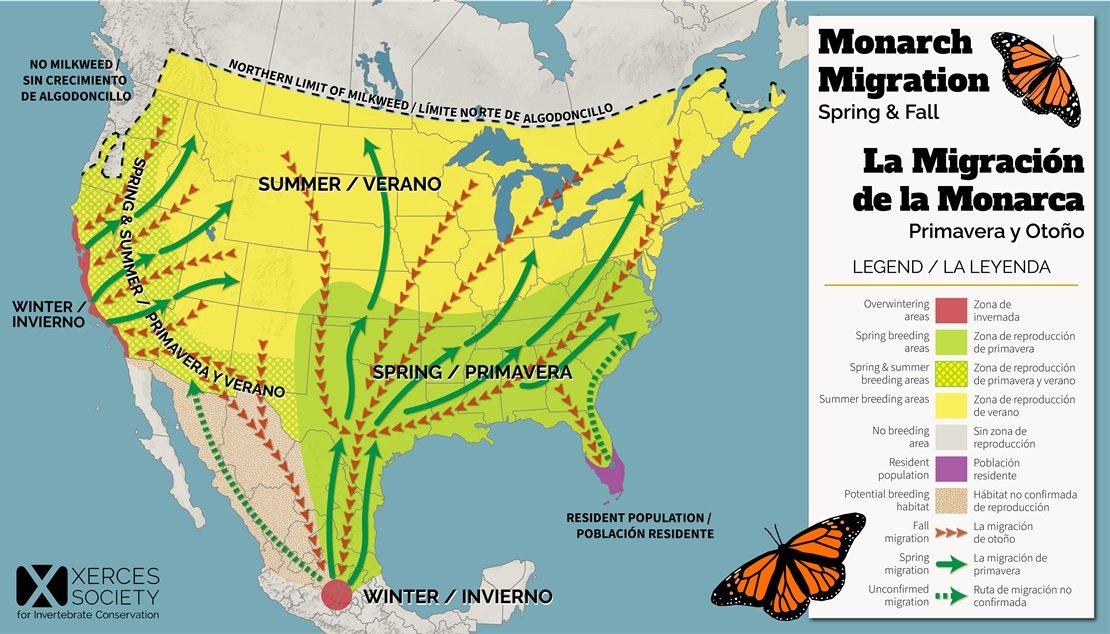
Used with permission of the Xerces Society
Across the spring, summer, and fall, monarchs disperse across North America. There are two groups of monarchs, the eastern monarch population, found east of the Rocky Mountains and the western monarch population, from the Rocky Mountains westward. These two monarch populations have quite different migration patterns. The eastern monarchs spend the winter in pine forests of Mexico and in early spring start traveling northward. They mate and lay eggs across the South (Texas to Florida). When those eggs mature, at least some of the new generation move farther north to the central U.S., where they mate and lay eggs. From mid-continent, a new generation continues northward to the northern edge of the United States/the southern border of Canada. At least some monarchs reach Minnesota and Maine by May and there will be as many as four generations in the north. (I don’t mean to imply that all the monarchs leave to go north; many remain in the south or mid-continent.) By August, all across the continent, monarchs are eating and growing. As the days shorten and the temperatures cool, monarch adults turn southward, flying to spend the winter on big pine trees at 6,000-10,000’ elevation in the mountains of Mexico; the most northerly monarchs may migrate 3,000 miles.
In contrast, the western monarch population overwinters in small patches of trees, usually pine and cypress, sometimes eucalyptus, found along the California coast, from just north of Watsonville, south along the coast to the Ensenada, Mexico, about 550 miles. Western monarchs travel north and east during the growing season, eventually reaching nearly the Canadian border and the western slope of the Rocky Mountains, turning southwest in the fall to spend the winter in groves on the coast.
Concerned biologists are carefully monitoring the monarch numbers, counting them in December and January when they are clustered at overwintering sites. In January 2024, numbers of the Eastern Monarchs had dropped precipitously (59%) compared to 2023. The decline was attributed to lower amounts of milkweed across their summer range, partly due from drought conditions and partly resulting from land development destroying milkweeds. Widespread use of pesticides also kills a lot of monarchs in all their life stages. For the Western Monarchs in January 2024, wintering numbers were up about 10% compared to 2023, though they were fewer than in 2022. Monarchs are capable of rapid increases in numbers, however, so work to aid them is ongoing.
Questions of monarch distribution and migration remain. Populations in south Florida appear to be resident, not migratory, so people living in south Florida need to take special care to have both milkweeds and nectar flowers for their monarchs. Eastern monarchs sometimes meet western monarchs and butterflies sometimes switch between the two populations, sometimes in New Mexico but also across the Rocky Mountains; not enough is known about how that happens and whether it is important.
Recent efforts have not yet begun to see the monarchs recover from having lost 90% of their butterflies over the last 30 years. The causes of monarch decline are a complex mix of cold weather slowing their development and making them vulnerable to disease and predators, loss of milkweeds for larvae to feed on, poor food availability (lack of flowers) as they disperse and migrate across North America, destruction of overwintering sites, and deaths due to pesticides. Of these, the most easily addressed is availability of milkweeds and nectar-containing flowers. For this, everyone across the continent can help by planting milkweeds for monarch larvae and flowers for adult monarchs.
Monarch caterpillars eat only milkweeds (genus Asclepias). To rear monarchs from egg to adult, milkweed plants are required. To help monarch populations recover, abundant food for the caterpillars—lots of milkweed plants—is essential.
No one species of milkweed grows all over the continental United States, so different milkweeds are recommended for different areas. The milkweed has to be growing vigorously enough that monarch caterpillars can eat it and grow without killing it. For that, a locally native, well-adapted milkweed is required. Of the 73 species of milkweed in the United States, those recommended for hosting monarchs are also the most attractive. See the Xerces Society or monarch rescue websites for detailed maps and species lists. For example, grow common milkweed (Asclepias syriaca) in the eastern U.S., white milkweed (Asclepias variegata) in the South, Arizona milkweed (Asclepias angustifolia) in Arizona and California milkweed (Asclepias californica). Each region has at least five recommended milkweeds. Whether your land is ordinary, or very sandy, or unusually soggy, there’s a native milkweed that will grow well for you.
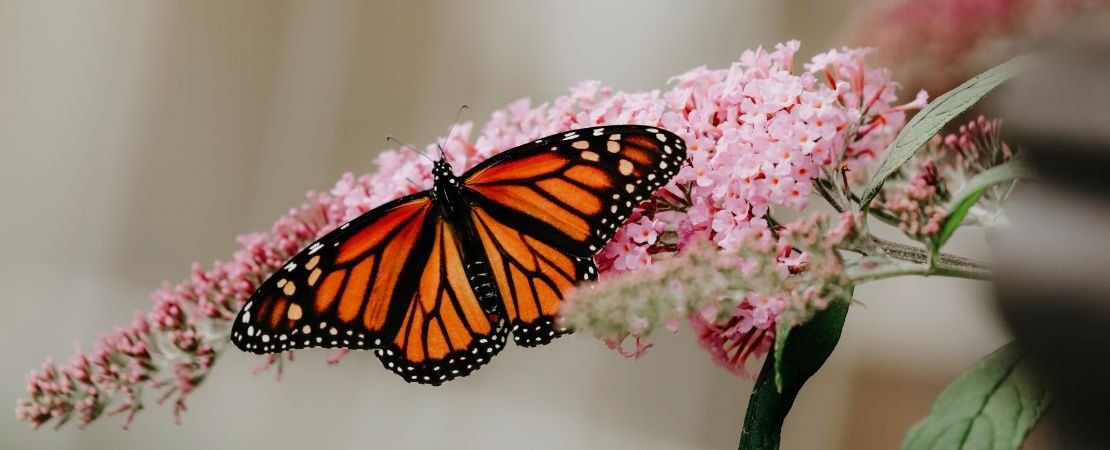
For adult butterflies, providing food is much easier: grow flowers. Plant lots of flowers, ones that open early in the spring to ones that bloom into late fall. More flowers are better; you do not want a week in which no flowers are open and the butterflies go hungry. Do not use pesticides. Wild insects like monarchs are very sensitive to even tiny amounts of insecticide. Don’t poison your butterflies.
Monarchs and other butterflies will feed on any flower that has accessible nectar. That includes the vast majority of garden flowers, from alliums to dianthus, echinaceas, monardas, penstemons, sedums, and zinnias. They like bright colors, large and small flowers, flowers flat like daisies or vertical like larkspurs. The few flowers they do not use have no nectar, such as wormwood, or nectar they cannot reach, for example inside the closed flowers of a pea blossoms. If nectar is present by day and accessible, monarchs will feed on it. Nectar is generally uniform in flowers from across the world, so monarchs will as happily feed from introduced ox-eye daisies and butterfly bush flowers as from native coneflowers and penstemons.
The answer to that is everywhere, because the goal is to build monarch numbers. If at any time or place in their life cycle they do not do well, there will be fewer butterflies for the next stage and beyond; each step is essential. American gardeners cannot do much to help overwintering butterflies in Mexico, but as soon as they start their migration help is welcomed. More flowers for adult butterflies and more milkweeds to lay eggs on across the South from Texas to Georgia provide more butterflies from Kansas to Virginia. If they do well in those middle states, then more mate and lay eggs from the Dakotas to Maine, making more monarchs there. And more monarchs heading south from northern edge of their range in October put more butterflies in the wintering grounds in Mexico, where, if they have a good winter, we start the cycle the next spring with more butterflies.

