Turn a fence, arbor, or trellis into a wall of ever-changing sunset color with this vigorous 10 to 12 foot climbing rose.
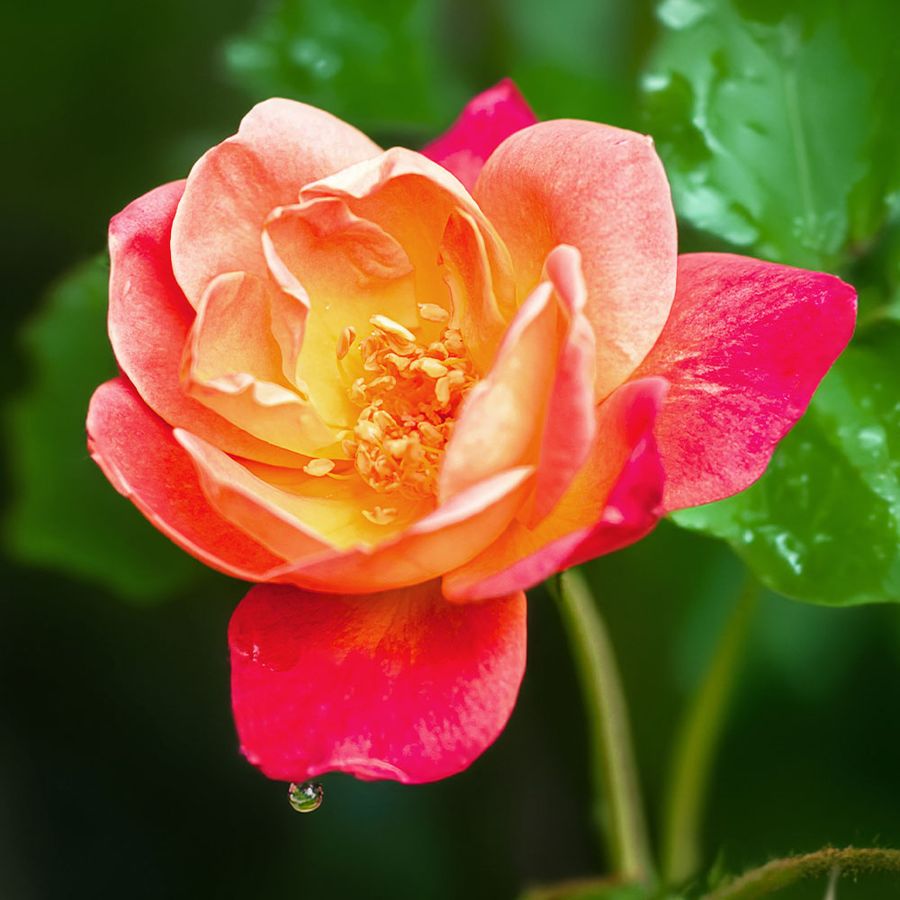
Cardinal-red buds open to golden-orange and yellow blooms brushed with crimson, creating multiple colors on the plant at the same time.
Joseph's Coat Climbing Rose transforms fences, arbors, trellises, and pillars into spectacular displays of ever-changing color. Cardinal-red buds open into 4-inch blooms glowing with marigold-orange and golden-yellow, touched with crimson before deepening toward red as they mature. Because flowers at different stages appear together, one vigorous plant can display red, orange, gold, and yellow at the same time, creating the effect of a sunset climbing across the garden.
Growing approximately 10 to 12 feet tall, Joseph's Coat has the scale to make a dramatic vertical statement. Train its sturdy canes along a sunny fence, over an arbor, or up a trellis or pillar and enjoy repeated flushes of colorful flowers over a long season. Glossy dark green foliage provides an attractive backdrop for the blooms, while mild fragrance adds another dimension to this classic climber.
Why You'll Love It
Transforms fences, arbors, trellises, and pillars with dramatic vertical color
Flowers change through shades of red, orange, golden-yellow, and crimson as they mature
Multiple bloom colors appear on the plant at the same time
Large 4-inch flowers contain up to 28 petals
Vigorous climbing growth reaches approximately 10 to 12 feet tall
Repeat flowering provides changing color over a long season
Glossy dark green foliage creates an attractive background for the bright blooms
Why This Rose Stands Out
Joseph's Coat does more than add flowers to the garden - it can transform an ordinary structure into a colorful landscape feature. Train it across a fence for a broad sweep of changing color, guide it over an arbor to create a flowering entrance, or grow it vertically on a trellis or pillar where its red, orange, gold, and yellow blooms can become a dramatic focal point.
The changing flowers are what make the display so distinctive. Cardinal-red buds open into warm marigold-orange and yellow blooms touched with crimson, then continue changing as they mature. New buds, freshly opened flowers, and mature blooms appear together, so the plant rarely looks exactly the same from one day to the next.
Plant Highlights
Rose Type: Climbing Rose
Breeders: David L. Armstrong and Herbert C. Swim
Bloom Color: Changing shades of cardinal red, marigold-orange, golden-yellow, and crimson
Bloom Size: Approximately 4 inches
Petal Count: Up to 28 petals
Fragrance Strength: Mild
Bloom Season: Late spring through late fall
Growth Habit: Climbing
Mature Height: Approximately 10 to 12 feet
Mature Width: Approximately 4 feet
Sun Exposure: Full sun
USDA Hardiness Zones: 5-9
Best Garden Uses: Arbors, trellises, fences, pillars, walls, and other vertical garden structures
Frequently Asked Questions
What makes Joseph's Coat Climbing Rose special? Joseph's Coat combines vigorous 10- to 12-foot climbing growth with flowers that change through shades of red, orange, golden-yellow, and crimson. Blooms at different stages appear together, creating a constantly changing display of warm color.
What color is Joseph's Coat Rose? Joseph's Coat is a multicolored rose rather than a single-color variety. Cardinal-red buds open into marigold-orange and yellow flowers touched with crimson, with the colors continuing to change as the blooms mature.
How tall does Joseph's Coat Climbing Rose grow? Joseph's Coat grows approximately 10 to 12 feet tall and about 4 feet wide. Its vigorous climbing habit makes it well suited to substantial vertical garden structures.
Where should I grow Joseph's Coat Climbing Rose? Grow Joseph's Coat in full sun beside a sturdy support such as an arbor, trellis, fence, pillar, or wall. Its long canes can be trained across the structure to create a broad display of flowers and foliage.
Does Joseph's Coat Climbing Rose bloom repeatedly? Yes. Joseph's Coat produces repeated flushes of flowers over a long season, allowing its distinctive mixture of changing colors to return throughout the growing season.
Is Joseph's Coat Rose fragrant? Joseph's Coat is mildly fragrant. Its greatest strengths are its changing flower colors, vigorous climbing growth, and ability to create dramatic vertical displays.
Does Joseph's Coat need a trellis? Joseph's Coat needs a sturdy structure for support and training. A trellis works well, but the rose can also be trained along fences, over arbors, around pillars, or against other suitable vertical structures.
Care Tips
Plant in full sun in fertile, well-drained soil near a sturdy support. As the canes grow, secure and train them across the structure rather than allowing all growth to extend straight upward. Spreading climbing canes more horizontally can encourage flowering shoots along more of the plant. Water deeply while the rose becomes established and during dry periods. Prune as needed to remove dead or damaged wood and to manage mature canes while preserving the framework needed for climbing.
Grow with Confidence
For more than 150 years, Jackson & Perkins has helped gardeners grow exceptional roses with confidence. Explore our expert resources for planting, care, pruning, seasonal maintenance, and more.
WARNING: This product can expose you to chemicals that are known to the State of California to cause cancer and birth defects or other reproductive harm. For more information go to www.P65Warnings.ca.gov.
Blooms are full and lightly fragrant. I love it, but it seems to grow slowly.
Denise Fields from KY
May 26, 2025
Not Professional
This shopper rated the product 1 out of 5 stars
On March 28 I placed an online order for 2 JC climbing roses and some rose fertilizer. I paid for expedited shipping. They were in stock and so when, a few days later (March 31) I received a box with fertilizer in it and no roses, I was stunned. I called customer service and said I did not pay expedited shipping for fertilizer. Where are the roses? I was told they were in stock and ready to ship.
Their official shipping calendar says that bare root roses are scheduled for early to mid March for my zone 7. Container planted roses are scheduled for mid to late April.
When I inquired on April 15 the email said “We show plants/roses to Idaho are expected to begin shipping mid April. That is to say that you will receive tracking information in the following days.” They must be going to send a containerized plant!
When I inquired on May 2 the reply was “We are getting your order prepared for shipment the roses are taking a bit longer to ship. They should ship this week. “
Next inquiry on May 7 was met with “We are sorry for the delay. We are getting your order prepared for shipment the roses are taking a bit longer to ship. They should ship this week.”
On May 12, I finally got a shipping notice. The roses came with a “Late Season Guide for Planting Bare Root Roses.” No kidding Sherlock!
The roses were bare root, dry with one of the three stems on one was dead brown. The other rose only had 2 stems and after 2 weeks of care, there's no evidence that they are going to sprout.
Beth McKinnon from ID
February 25, 2025
Multi color climbing rose
This shopper rated the product 5 out of 5 stars
Love all the colors advertised on this climber. Got it into the ground and can’t wait to see it bloom!
Michele from TX
Choosing Your Roses
Bare root roses are the most common form of roses for spring and early season planting, and come in two types: grafted and own root.
Grafted roses, sometimes referred to as budded bare root roses, have roots that belong to a different variety of rose than the shoots. While the shoots will grow into the variety of rose you've selected, the root variety has been specially grown and developed for hardiness, improved resistance to common diseases, and improved resistance to certain weather conditions. The roots on any grafted rose you receive are usually already two years old, so they'll establish in your garden more quickly when planted.
Own root roses are grown from rose shoot cuttings and develop their own root system. Unlike grafted roses, both their roots and shoots come from the same variety of plant.
All Jackson & Perkins bare root roses are maintained in a suspended state of growth in our state-of-the-art wet cooler, so they'll be delivered to you with no foliage or blooms. The wet cooler has a uniform storage temperature set just above freezing and uses a fog system to provide consistent humidity of 100%, ensuring the roses remain fully hydrated and don't exit dormancy before leaving our facility. While you might see some variance in size, even within the same variety of bare root rose, all our roses meet the same rigorous standards of quality.
So, not sure which type of bare root rose you should choose? Don't worry, we've got that covered. We've researched which varieties of bare root roses grow better as grafted or own root, and both types can be planted in the early spring months, so just choose the variety of rose you're most interested in and get planting.
Though you might be surprised or intimidated when you receive a box of bare root roses filled with roots and shoots, rest assured, with the proper care, these little bundles will grow into stunning roses.
Container Roses
Container roses are typically available in 2-quart sizes or larger and come with established foliage that may or may not have blooms. While bare root roses should generally be planted in early spring, container roses allow you quite a bit more flexibility in planting time, from spring all the way through fall in many zones. Fall can be a good season to plant container roses because it allows them enough time to establish themselves before cold or freezing temperatures arrive.
Jackson & Perkins World's Finest Roses
The Jackson & Perkins Difference
Jackson & Perkins is one of the most recognized names in the gardening industry. In fact, for decades rose lovers have considered Jackson & Perkins synonymous with great roses. How has Jackson & Perkins earned this reputation? Simple, for over 100 years we have brought our customers the world's finest selection of roses.
Jackson & Perkins became a leader in the world of roses by producing dozens of award-winning roses. Jackson & Perkins has won more All-America Rose Selection awards than any other US company. In addition to the AARS awards, Jackson & Perkins has won numerous other awards, including the coveted Golden Rose of The Hague and the Royal National Rose Society’s President’s International trophy, among others.
From seed to market a new garden rose can take 8 to 10 years to develop. Every year, thousands of seedlings are grown but only a handful are selected to move into the trial phase. During this time, potential new roses are grown and evaluated in different climatic regions of the country. Our rosarians are looking for rose bushes that have stronger disease resistance, vigorous growth habits, and clean healthy foliage. When it comes to blooms, they are looking for improved flower form, unique colors, and strong fragrance.
Today Jackson & Perkins offers over 200 varieties of roses that includes a broad selection of exclusive roses, historical favorites, and innovative genetics from hybridizers around the world. We have two seasons each year for roses. In the spring, we offer bare root rose bushes, bare root 36” trees, 24” patio trees, and container grown roses. Our fall season is all bush roses, and they are available in 2QT and 1GL containers.
Whether you are new to roses or are an experienced rosarian, our online store has rose varieties for you. Our website is packed with information. You will find each rose fully described and lots of articles and videos that will help answer all your questions. Our call center staff have decades of experience and are just a phone call away.
Jackson & Perkins is here to help you in every way on your rose-growing journey. There is no other plant in the garden that comes in more colors, fragrances, shapes, or forms, or performs as many functions than roses do.


 Video
Video 


